Home•Stories•Insightful Articles
Why Kenya Is Rewriting the Rules Around Sugar, Salt, and Processed Foods
As obesity and chronic diseases rise, Kenya is turning to stricter nutrition policies that reach schools, markets, and supermarkets.

What Urbanisation Did to the Kenyan Plate
Between 2000 and 2023, adult obesity rates in Kenya tripled, with nearly half of women and close to one in five men now overweight or obese, while diet-related non-communicable diseases account for nearly 40% of all deaths and more than 50% of hospital admissions. Kenya now sits at a tense point in public health, where everyday food choices link directly to rising illness.
Walk through Nairobi or Mombasa, and the pattern is easy to notice. Roadside vendors, supermarket aisles, and school canteens offer more highly processed foods high in sugar, salt, and unhealthy fats. Prices stay low, availability stays high, and daily diets shift. Diabetes, hypertension, and heart disease follow.
Policymakers are no longer relying on general dietary advice. A different response is taking shape through food system reform. Kenya Nutrient Profile Model, KNPM, sits at the center of this shift, designed to guide front-of-pack labeling, marketing restrictions, and school food standards.
Choices made here extend beyond individual plates. Citizens, businesses, and policymakers across Africa are watching how evidence-based nutrition policy plays out in practice, with early actions and measurable outcomes beginning to appear over time.
Early signals point back to a deeper issue inside Kenya’s food system. Rapid urbanization has shifted diets toward packaged and ultra-processed foods, many exceeding recommended thresholds for sugar, salt, and unhealthy fats. A government assessment puts the number plainly. Only about 10% of processed and packaged foods sold in Kenyan supermarkets meet basic nutritional criteria. Most fall into the unhealthy category.
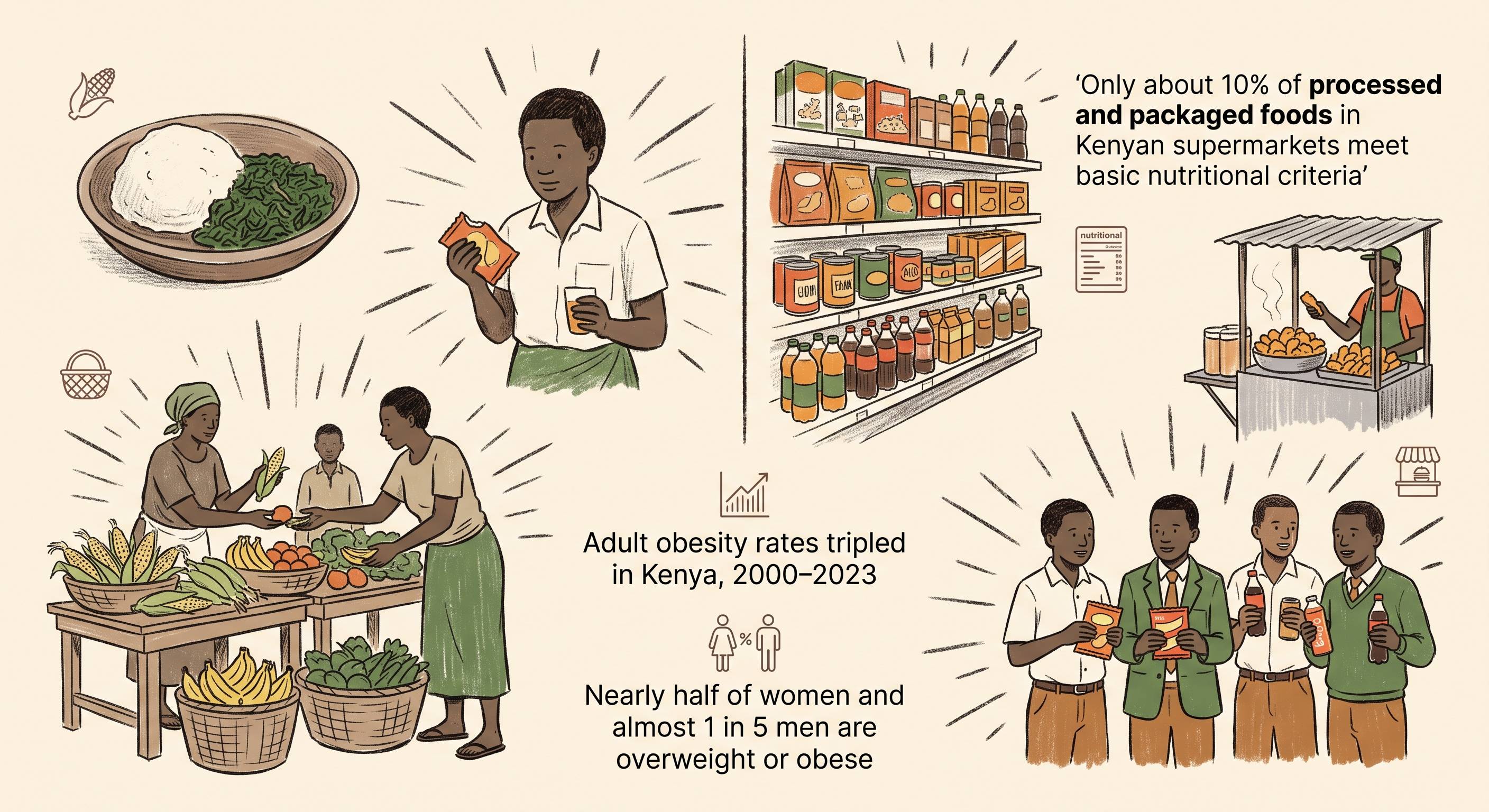
Urbanisation and Kenya’s changing plate (Susinsight / Tomi Abe)
Daily life makes this hard to ignore. Retail shelves carry products that cross nutrient limits, and research shows children see frequent advertising for sugary drinks and ultra-processed snacks in schools and public spaces. Exposure starts early, long before any policy reaches them. Habits form in small moments. A child buying a bright bottle after school, a quick snack chosen for price, is not content.
Pressure builds in two directions at once. Overweight and obesity continue to rise, yet undernutrition and micronutrient deficiencies remain, especially among low-income populations. Many families cannot afford balanced diets. Effects show up in cognitive development in children and later in a higher risk of chronic diseases.
Attempts to rely on awareness have not gone far. Voluntary reformulation has been slow. Advertising keeps pace, often ahead of nutrition messaging, especially for sugary beverages and snacks aimed at children. Food systems shape what shows up on shelves and what people can afford. Consumer knowledge alone struggles in that space. Kenyan policymakers have started acting on that gap through KNPM.
Warning Labels Where Dietary Advice Failed
KNPM sits at the center of this response, shaping how rules translate into what people actually see and buy. Kenya Nutrient Profile Model sets clear limits for sugar, salt, and unhealthy fats across foods and beverages, then connects those limits to policy actions. Front-of-pack warning labels, marketing restrictions, and standards for school and institutional food procurement all follow from this structure.
Front-of-pack labeling focuses on visibility. Packaged products that exceed nutrient thresholds carry simple warnings such as “High in Sugar” or “High in Salt,” placed inside black octagonal symbols. A shopper standing in a supermarket aisle can read those labels in seconds. No technical breakdown, no guesswork.
Marketing restrictions narrow what reaches children. Advertising of unhealthy products faces limits, especially in spaces where children spend time. Early exposure shapes taste. A child who sees fewer sugary drink ads may lean toward different choices over time.
School food rules work alongside this. Guidelines push schools to reduce ultra-processed items and offer more nutritious meals. KNPM also follows standards linked to the World Health Organization while adjusting to Kenya’s context. The Ministry of Health and the Kenya Bureau of Standards are working together to turn these rules into enforceable actions.
Work on the ground is starting to show up in Nairobi and Mombasa, where policy ideas meet daily routines in shops, schools, and markets. KNPM now guides what products appear on shelves and how they are presented. Authorities have begun drafting regulations for front-of-pack warning labels and setting stricter food standards for public services such as schools and other institutions. Nutrient thresholds for sugar, salt, and unhealthy fats shape these rules, with a clear aim to raise awareness and reduce exposure to unhealthy products linked to diet-related non-communicable diseases.
Evidence from early research gives a clearer picture of how this plays out. Studies in Nairobi and Mombasa show that visible warning symbols help shoppers spot foods with excessive nutrients. Randomized trials found that people who saw these labels were better at identifying nutrients of concern and showed lower intent to buy unhealthy items compared with products without labels.
Changes are also appearing inside public institutions. Pilot school programs aligned with national nutrition and school health policies now include fortified porridge, beans, vegetables, and fruit, while sugary drinks and HFSS snacks are discouraged. Vendor training is part of this shift. Market vendors who joined nutrition sensitization programs have started reducing salt, sugar, and oil in prepared foods and stocking healthier packaged options. Monitoring exercises have noted gradual changes in what is available in urban markets.
Data from independent assessments of 30 major food and beverage companies shows nearly 90 percent of packaged foods in Kenyan retail exceed proposed nutrient thresholds and would require warning labels under KNPM. Monitoring plans rely on audits and data collection to track how these changes unfold.
Reform Does Not End at the Ministry Door
Work now stretches beyond government offices, pulling in research groups, advocacy organisations, and industry voices. Conversations at forums such as the East Africa Regional Dialogue on transforming markets for nutritious foods bring these groups into the same room. Ministry of Health joins civil society, academia, and private sector representatives to compare evidence and test ideas. The African Population and Health Research Centre plays a visible role in these discussions, pushing for clear nutrient thresholds and accountability mechanisms that keep public health concerns in focus.
Responses from food companies have not followed a single pattern. Some are testing product reformulation or joining early labelling efforts, while others move more slowly. Ongoing front-of-pack labeling development includes randomized consumer experiments carried out in Nairobi, Mombasa, Kisumu, and Garissa. Participants interacted with prototype warning labels placed on fictional packaged foods. Results showed a clear shift. Consumers identified products high in sugar, salt, and fat more accurately and showed lower intention to purchase items such as sugary drinks and salty snacks. Industry discussions linked to KNPM have also explored gradual reductions in sodium and sugar to meet proposed thresholds.
Independent assessments from Access to Nutrition Initiative suggest most companies have not yet aligned with front-of-pack standards, especially on responsible marketing and voluntary use of nutrient profile benchmarks. Gaps between policy direction and business practice remain visible.
Public debate reflects similar friction. Kenyan legislators have questioned how compliance will be enforced and how misleading nutrition claims will be handled. Manufacturers and retailers need clarity on expectations, while enforcement bodies need capacity to act. Balancing public health goals with economic concerns continues to shape these discussions, and no single group controls how fast change moves. Questions around new labelling rules illustrate these tensions.
Despite these challenges, Kenya’s experience highlights the importance of combining leadership from government with sustained engagement from civil society and constructive participation from business actors. Strengthening enforcement capacity — such as monitoring compliance, clarifying standards, and supporting accountability — remains critical to ensuring that nutrition policies are more than symbolic commitments. When these sectors work together with shared evidence and objectives, policies are more likely to translate into real improvements in food environments rather than remaining aspirational targets.
Momentum now depends on how far enforcement and coordination can go across Kenya’s system. National and county authorities carry that responsibility, especially in monitoring compliance with nutrition standards and linking food policy with trade, education, and agriculture. Stronger alignment means rules do not stop at paper. School meals, workplace canteens, and open markets begin to follow similar standards, backed by enforcement where gaps appear. The Ministry of Health has already pointed to cross-sector coordination as part of efforts to address diet-related non-communicable diseases.
Progress toward 2030 can be tracked through clear signs. Childhood overweight rates can fall. School meals can meet nutrient standards more often. Sales of foods high in sugar, salt, and saturated fat can drop. Research in Kenya already shows that front-of-pack warning labels reduce intentions to purchase unhealthy foods. Reaching those outcomes depends on several moving parts. Businesses need to follow reformulation timelines. Civil society groups such as Access to Nutrition Initiative and INFORMAS can continue Food-EPI-style assessments. County governments can test digital tools that track vendor compliance and retail conditions.
Regional links bring another layer of pressure and opportunity. Kenya works within the East African Community, where shared standards can shape trade and regulation across borders. Discussions at the April 2025 East Africa Regional Dialogue on food policy included delegates from Kenya, Tanzania, and Uganda. Conversations focused on aligning nutrient profiling and front-of-pack labelling frameworks so countries are not working in isolation.
Food policy here has started to move beyond health ministries. Nutrition rules now influence how manufacturers adjust products and how retailers present them. Reports on packaged foods in Kenya show most still fall short of healthy thresholds, which keeps pressure on both policy and industry.
A reader watching this unfold may notice a simple shift. Government is no longer stepping back from the food environment. Rules are being written, tested, and adjusted in real settings. Kenya’s approach does not settle every tension between health goals and market forces, but it shows how policy can move closer to everyday choices people make, from strengthening enforcement to deepening regional collaboration.
Written By

Adetola is a Contributing Researcher and Writer at Susinsight.
Filed Under
Region:
Countries:
Series:
World Days:
How helpful was this story?