Lagos Turns Its Waste Problem Into a $2.5 Billion Question
In mid‑2026, Lagos is facing up to 15,000 tonnes of daily waste and betting that sorting, recycling and new infrastructure can turn part of it into economic value.
Author
Editors
Published
August 7, 2026
Read Time
6 min read
Views
—
Lagos produces between 13,000 and 15,000 tonnes of waste every day, while the state is advancing a much larger idea: that part of what currently ends up in landfills could become an economic resource. The Lagos State Waste Management Authority (LAWMA) has estimated the potential annual value of a circular economy at about $2.5 billion, but that figure describes an opportunity, not money already being generated. The distinction matters because Lagos has spent decades trying to manage the basic problem of collection and disposal. The current push adds recycling, composting, waste-to-energy, and payment for recyclable materials to that effort.
The question now is less about whether waste has value. Lagos already has a market for plastics, metals, glass, cardboard and other recoverable materials. The harder question is whether the state can build a system that separates those materials early enough, collects them reliably and moves them to buyers at a scale large enough to support the $2.5 billion estimate.
The latest developments bring several programmes together, although they did not begin at the same time; for example, the Federal Airports Authority of Nigeria (FAAN) launched the first phase of its airport recycling programme at Murtala Muhammed International Airport (MMIA) on July 22, 2026. Reports around the launch described indoor colour-coded bins as the first step. The second phase involves outdoor collection bins, while the third is expected to bring certified waste companies into the process to collect plastics, glass, cans and organic waste for recycling facilities.
The numbers from the airport show why the programme was introduced. FAAN said 1,446 tonnes of waste from MMIA went to landfill in 2023, while another 1,383 tonnes went there in 2024, all unsorted before the new programme. Public reporting has yet to establish how much airport waste has been diverted since the new system began.
Lagos had already started experimenting with financial incentives for recycling. The Cash for Trash, also referred to as Trash for Cash, programme was launched on October 20, 2025. Government messaging described a weekly Thursday initiative operating across Ikeja, Badagry, Ikorodu, Epe and Lagos Island, where residents could bring recyclable materials, have them weighed and receive payment.
That programme sits within a broader Waste to Wealth approach promoted by the Lagos Ministry of the Environment and Water Resources under Commissioner Tokunbo Wahab and implemented with LAWMA.
The $2.5 billion figure came earlier. On March 31, 2025, LAWMA Managing Director Dr Muyiwa Gbadegesin said Lagos could potentially divert as much as 10,000 tonnes of waste every day into productive uses and generate about $2.5 billion a year in economic value through a circular economy. That estimate should be read carefully, as it is not annual revenue currently entering government accounts, and no published evidence establishes that Lagos is recovering 70% of its waste. The estimate covers potential economic activity involving recovered materials, recycling, composting, energy recovery and related businesses.
A city producing 13,000 tonnes of waste each day cannot solve the problem simply by finding more space to dump it. At that daily rate, the annual volume is about 4.75 million tonnes. The upper estimate of 15,000 tonnes per day corresponds to roughly 5.46 million tonnes annually.
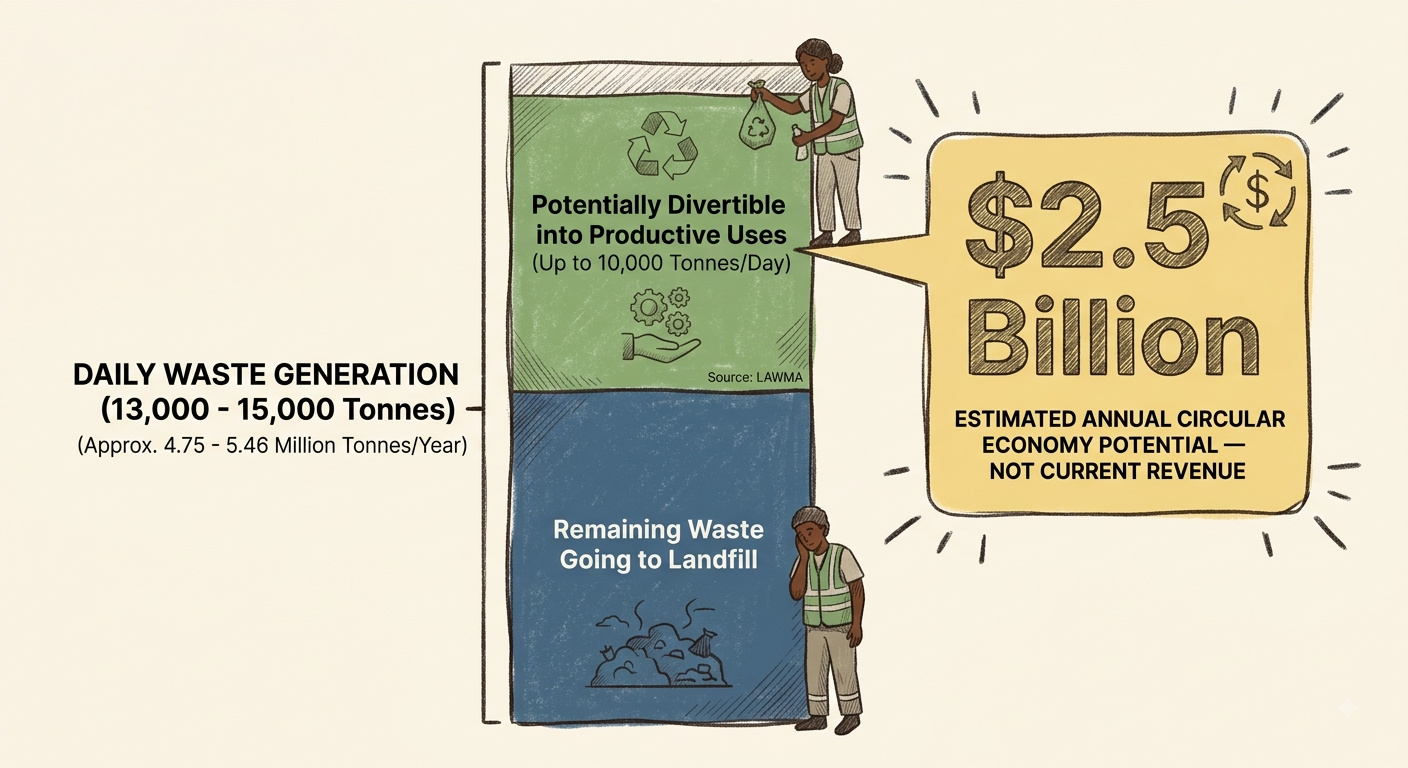
Lagos daily waste and circular economy potential (Credit: Susinsight / Tomi Abe)
That scale makes the economics harder to ignore. A plastic bottle that has been separated before collection can have a buyer. Mixed with food waste, mud and other refuse, the same bottle becomes more expensive to recover and less useful to a recycler.
Source separation therefore sits near the centre of the problem, although calling sorting the only bottleneck would miss much of what is happening. Lagos also needs more collection vehicles, transfer stations, functioning disposal sites, reliable recycling buyers, financing and stronger compliance from residents and businesses.
LAWMA’s current infrastructure plans show how large the gap remains. The authority has said Lagos needs roughly 2,000 compactor trucks for efficient collection. It has reported receiving 10 additional trucks and expects about 150 more.
The authority is also constructing or rehabilitating seven transfer loading stations at Olusosun, Solous, Ikorodu, Iberekodo, Ijegun, Agege and Oshodi, while estimating that about 20 will eventually be required. A material recovery facility under construction in Ikorodu is projected to mechanically recover about 90% of incoming waste. That is a design or projected capacity, not a statewide recovery result.
Infrastructure around Olusosun is expected to process approximately 2,500 tonnes daily. The projects were reported as expected to become operational in the first quarter of 2027, with LAWMA forecasting about 5,000 direct jobs.
Those figures offer a clearer picture of the scale of the ambition. Lagos is trying to build a chain that begins with collection and sorting and ends with materials being recovered, sold, reused, composted or converted into energy.
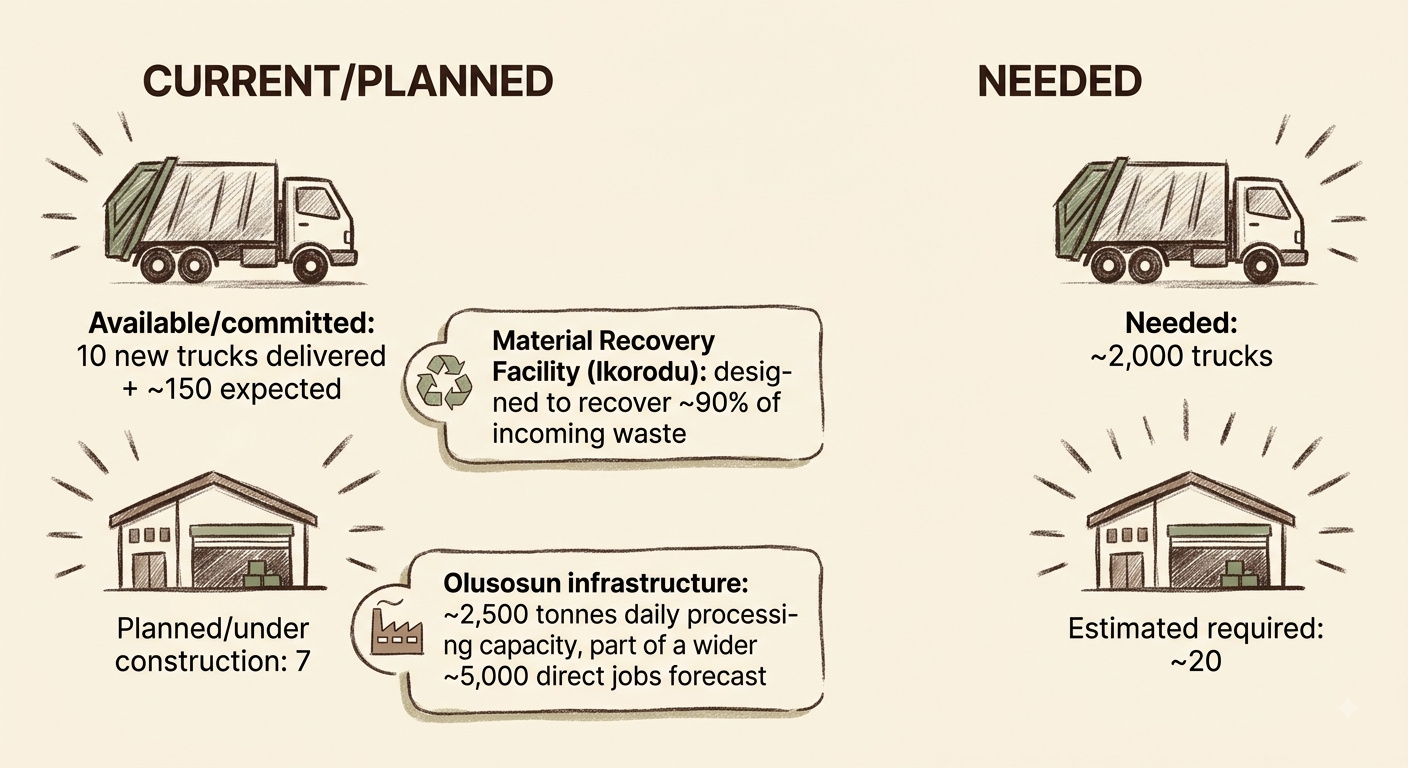
Lagos waste infrastructure gap current vs needed (Credit: Susinsight / Tomi Abe)
Lagos’s waste problem has been building for decades, and the Lagos State Refuse Disposal Board was established in 1977, during a period of rapid urbanisation, population growth and the preparations surrounding FESTAC ’77. The organisation became the Lagos State Waste Management Authority under Edict No. 55 in 1991.
Private Sector Participation (PSP) in waste collection began as a pilot in Kosofe and Bariga in 1997. LAWMA later took responsibility for restructuring and monitoring PSP operations in 2007. The Cleaner Lagos Initiative in 2017 attempted another major reorganisation of waste collection and private-sector participation, but disputes and implementation problems followed.
A 2020 LAWMA recycling handbook already described community recycling centres and separate recycling zones. Plans for composting, biogas and waste-to-energy facilities at Olusosun, Epe and Badagry were publicly outlined on July 18, 2024.
The current reforms therefore have a long policy history behind them. The difference now is the combination of consumer incentives, airport sorting and heavier investment in transfer and recovery infrastructure.
The pressure on existing disposal sites is also becoming harder to ignore. LAWMA said in July 2026 that Olusosun and Solous III were approaching the end of their operational lives, with heavy rainfall, ageing infrastructure and waste backlogs adding to the strain.
A circular system offers a different way of thinking about that pressure. Plastics, paper, metals, glass and cardboard can return to manufacturing. Organic waste can go towards compost, biogas, animal feed or energy. Businesses can emerge around collection, sorting, aggregation, processing and logistics.
This headline estimate will eventually need more than repetition. Lagos should publish the assumptions behind the figure, including recovery rates, material prices, operating costs, capital requirements and the distinction between gross sales and net economic value.
Cash for Trash also needs dependable collection points, transparent prices, and dependable buyers. Asking residents to sort recyclable materials creates frustration if the separated materials later return to the same mixed collection stream.
Informal waste pickers deserve attention here. They already recover valuable materials from the waste stream, although the Cash for Trash programme has been described primarily as a payment scheme for residents rather than a formal employment or integration programme for informal workers. Any future formalisation should improve safety and income rather than simply remove people who already understand the recycling market.
FAAN faces a similar test. The colour-coded bins are a beginning, but the real measure will come later, when the airport can show how many tonnes were separated, where the material went and how much avoided landfill.
Lagos has spent years trying to collect waste faster. The next phase requires knowing what happens to that waste after collection. That means measuring tonnes recovered, households participating, payments made, jobs created, and material actually kept away from landfills.
The strongest test of the circular economy idea will therefore be fairly simple: show the material, the money, and where the waste went. If Lagos can do that consistently, the circular-economy projection becomes something that can be tested against reality rather than a headline figure. If the numbers fall short, the same transparency will show where the system needs fixing.
Written By

The Trending Desk delivers timely headlines and insights on the stories shaping Africa's future.
Filed Under
Region:
Countries:
Series:
How helpful was this story?