Why School Feeding Has Become Essential Infrastructure in Mauritania
From education and nutrition to social protection and refugee integration, school meals now support multiple systems around M'bera and Hodh El Chargui.
Author
Editors
Published
June 14, 2026
Read Time
12 min read
Views
—
Where Hunger and Displacement Share a Classroom
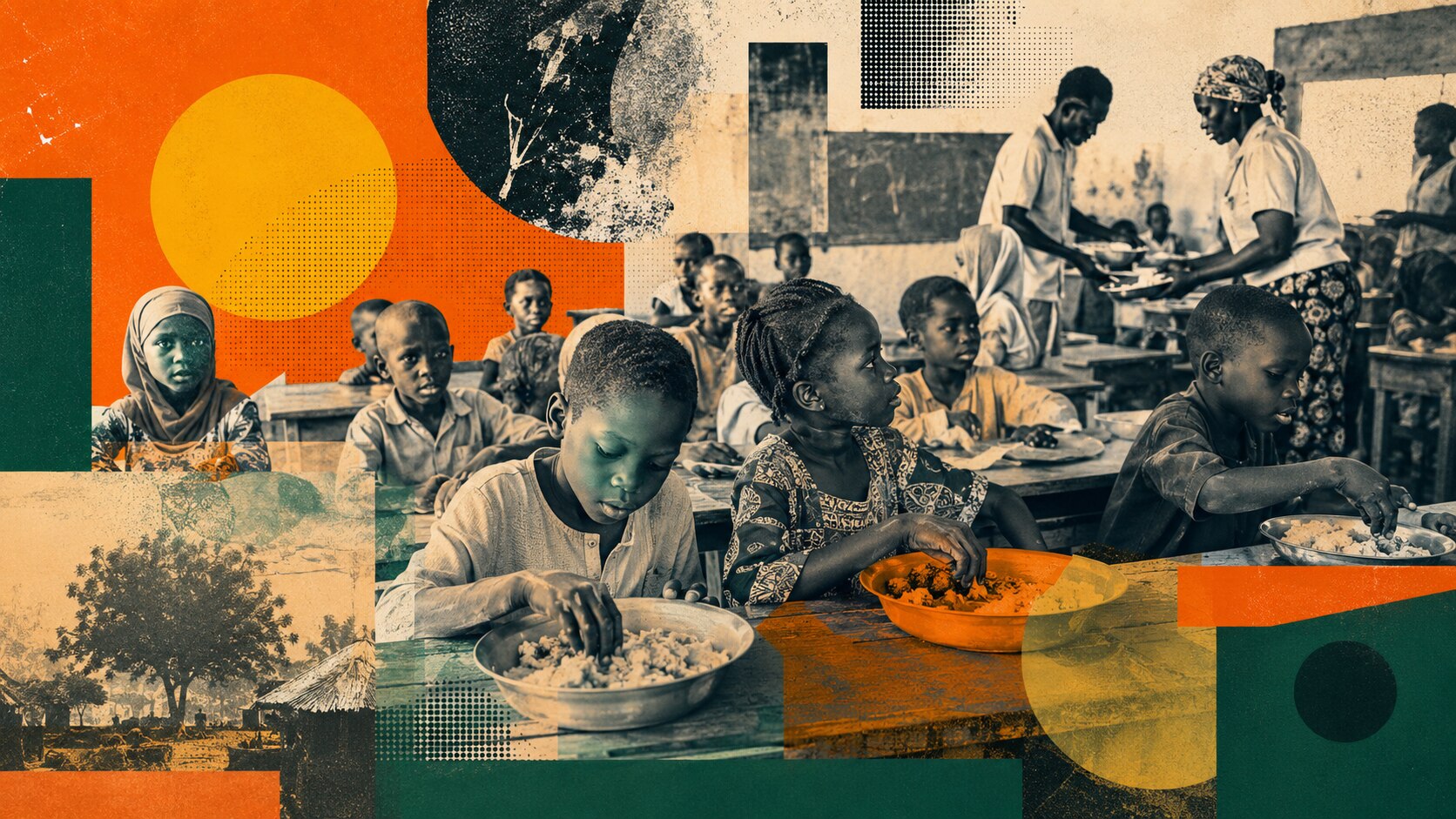
Morning light falls across a classroom in Bassikounou, where children gather around a table and wait for steaming plates of food. Many rely on this meal as the most consistent food they receive all day. Scenes like this appear across parts of Mali where food insecurity shapes daily routines. The World Food Programme and its partners provide meals to more than 114,000 students in 656 primary schools. Attendance rises, and basic nutrition improves in places where access to food often breaks down.
Roughly 1.5 million people face acute food insecurity in Mali, including many children who depend on aid. Conflict, climate pressure, and COVID-19 disruptions sit behind these numbers and shape how families move and settle. Shared meals inside school grounds bring refugee and host children into the same routine, often for the first time. Volunteers serve food, teachers keep order, and students sit side by side, learning names and habits. School feeding here connects education with daily survival and shapes how communities relate to each other. Experiences in Bassikounou reflect similar efforts across the Sahel region.
Shared routines like school meals sit against a longer history of movement and strain. Mali’s refugee crisis began in 2012 after armed conflict spread across the north, when Tuareg separatists and Islamist insurgents took control, and violence pushed families across borders into Mauritania. Mali’s refugee crisis reshaped mobility patterns across the region. Bassikounou, located in Hodh El Chargui, became a main entry point, partly because the M’bera refugee camp was set up nearby.
Numbers kept rising over time. Late 2024 records show about 110,000 Malian refugees in M’bera, far beyond the planned 70,000 capacity. Hodh Chargui region held around 242,000 refugees, including roughly 132,000 living within host communities. February 2025 estimates place the combined population of M’bera and nearby areas close to 160,000. These February 2025 figures show how quickly displacement reshaped local demographics. Daily life adjusted around these shifts, often without enough preparation or space.
Rainfall in Hodh El Chargui rarely reaches 20 mm a year, leaving little margin for farming or grazing.
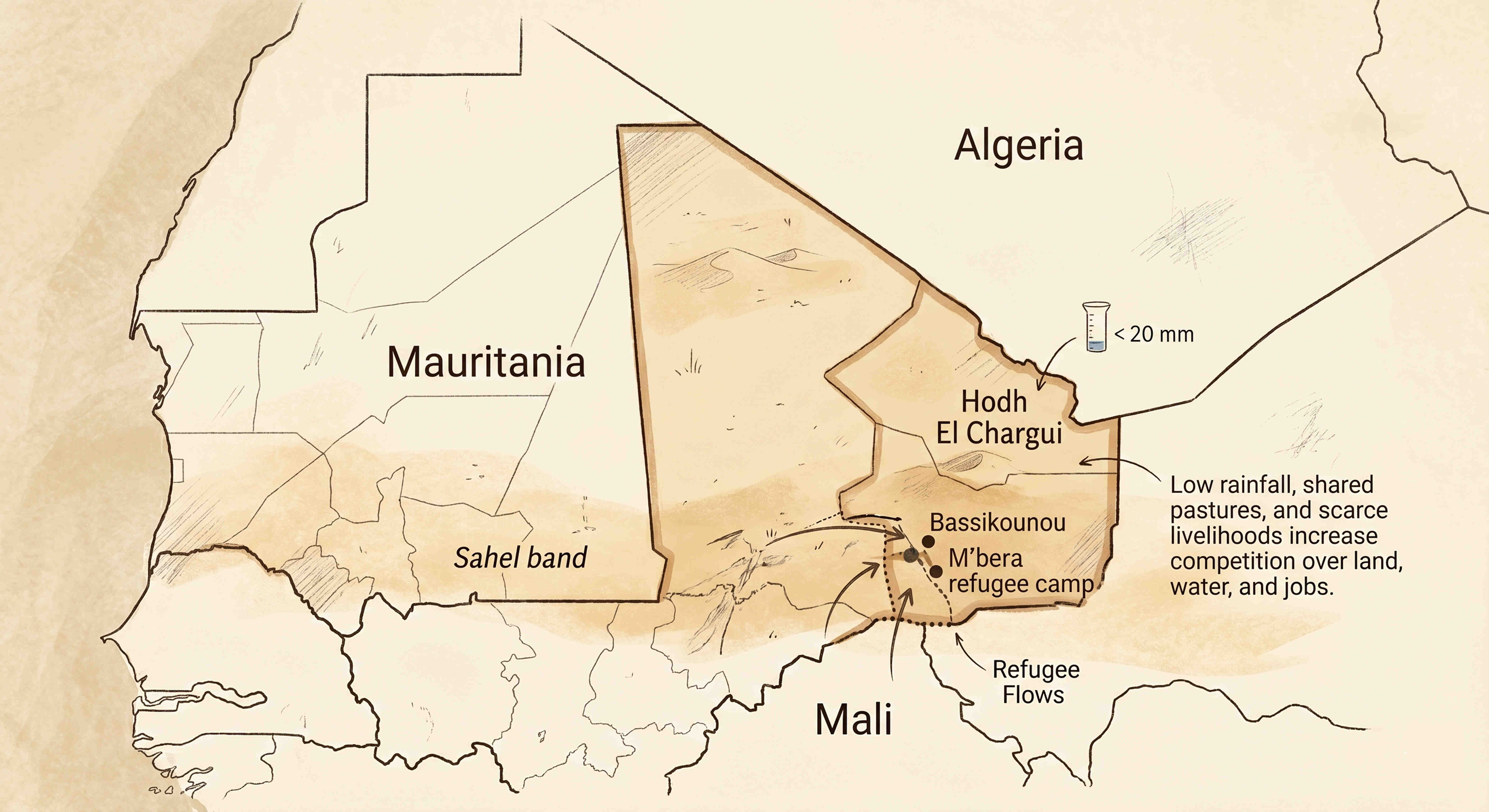
Low‑rainfall Hodh El Chargui, where refugee flows and school feeding collide. Susinsight / Tomi Abe
Refugee livestock and herds from returning pastoralists share the same dry land and water points. Pastures thin out quickly, and access becomes contested. Land, water, and informal jobs turn into daily concerns rather than abstract issues. These patterns of shared pastures and competition shape everyday interactions.
Host communities face their own limits. Employment remains low, and drought conditions reduce options further. Some families take in newcomers while managing their own shortages. Limited arable land and fragile Sahelian ecosystems heighten pressure on livelihoods. Aid does not always reach both groups equally, and that gap can shift how people relate to each other. Tension does not always appear openly, though small disagreements over resources can build over time. Humanitarian actors note that host populations often shoulder disproportionate burdens with limited support.
Earlier aid responses focused on immediate relief but often worked in separate tracks. Infrastructure gaps, distance, and access issues slowed delivery in remote areas. Programs that treated refugees and hosts differently sometimes reinforced the distance between them. Recent efforts move toward shared systems. UNHCR and the International Labour Organization support joint livelihood programs, aiming to place both groups within the same economic and social space rather than apart.
The Architecture Behind a School Feeding Program
Joint programs start to look different when daily services overlap. Mauritania’s Integrated School Meal Model began in 2018 through a partnership between the World Food Programme and the United Nations High Commissioner for Refugees, with the Government of Mauritania directly involved. Public institutions do more than approve plans here; they align school feeding with national systems and keep both refugee and host children inside the same structure. Activities in and around M’bera camp show how this integration works in practice.
School meals sit within a wider policy setup that links to Tekavoul and Inaya. Tekavoul provides cash transfers to households with limited income, while Inaya focuses on health services, especially for mothers and children across both communities. School feeding connects with these programs, so a child receiving food at school may come from a household receiving cash support and basic healthcare at the same time. This overlap shapes how families manage daily needs and aligns with national social protection goals.
Targeting follows a shared method rather than separate lists. The World Food Programme and United Nations High Commissioner for Refugees use a joint system built on the Joint Assessment Framework and Joint Targeting Principles. Households are assessed across food security, income, protection, and social vulnerability. Selection then includes children from both refugee and host groups under the same criteria, which changes how access is perceived inside classrooms. The Joint Assessment Framework provides common tools for analysing vulnerability.
Early results show scale rather than claims. During the last quarter of 2018, around 59,000 primary school children received meals across Mauritania, with 45% girls and 55% boys. Mbera refugee camp, hosting over 118,000 Malian refugees, received emergency school meals alongside nearby host communities. Numbers show reach, though daily experience depends on how these systems continue to operate in practice. Emergency school meals have become a key part of basic services.
Bassikounou offers a clear example, where school feeding programs reach both refugee and host children and shape how often they attend class. Families dealing with food shortages often weigh school against daily survival, and a guaranteed meal changes that calculation. Attendance rises, especially among children who might otherwise stay home.
Global evidence gives a reference point. A systematic review of 57 studies across low and middle-income countries found school feeding increased attendance by 2.6% of school days. Numbers like this seem small until placed in fragile settings where even a few missed days can lead to withdrawal. Schools supported by the World Food Programme in Bassikounou report similar patterns, with refugee girls showing some of the most noticeable changes in daily presence. Local assessments highlight these shifts in enrolment and regularity.
Girls in these communities face specific pressures. Early marriage and household responsibilities often interrupt schooling before age 12. Meals at school reduce one immediate burden on families, which makes continued attendance easier to justify. In Bassikounou and similar refugee settings, girls face heightened risks of early marriage or being pulled into unpaid work at home. World Food Programme notes that enrolment and retention tend to improve under these conditions, especially among vulnerable groups.
Fortified meals reduce undernutrition and anemia, both of which affect concentration and physical development. Studies show average gains of 0.32 cm in height and 0.58 kg in weight over 12 months compared to children who do not receive school meals. Better nutrition supports attention in class, and teachers often notice the difference during lessons.
Community behavior shifts in quieter ways. Parents engage more when food is available at school, partly because one daily need is covered. Teachers report fewer absences and more consistent participation. Experiences from Mali’s school nutrition programs show similar effects, where school meals promote attendance in vulnerable areas. World Food Programme describes this clearly: “nutritious school meals provide a strong incentive for families to send their children to school and keep them there, boosting attendance and improving children’s ability to concentrate in class”, a message echoed in regional school-meal responses.
Practical limits still shape delivery. Hodh Ech Chargui faces seasonal pressure, where “the rainy season is exacerbating food insecurity, road conditions, and limited market supplies are constraining access to food.” Funding gaps also affect scale, and “WFP was forced to reduce the number of school meal rations in Mauritania.” Transport and school infrastructure in Bassikounou influence how consistently meals reach students each day, as shown in education reports from the camp and host communities.
These impacts are closely aligned with global development goals. By reducing hunger and malnutrition, school feeding directly advances SDG 2, while increased attendance, retention, and equity in education contribute to SDG 4. In this way, Bassikounou’s school feeding initiatives exemplify how integrated approaches can address both immediate humanitarian needs and long-term human capital development.
Eating Together Does Not Guarantee Peace Alone
Daily constraints around food and work continue to shape how people relate in Bassikounou. Southeastern Mauritania hosts a large share of Malian refugees, many living in M’bera camp. End of 2024 estimates place the combined population of the camp and nearby areas at around 160,000 people. Demand for water, land, and jobs rises with these numbers, and small disputes can grow when options remain limited. The influx of refugees has intensified competition over already scarce resources.
School meals enter this space in a practical way. World Food Programme expanded coverage to include both groups, reaching 7,700 refugee children and 46,800 Mauritanian children from host communities from 2024 to 2025. Shared access means children eat in the same place at the same time, which reduces visible differences during the school day. Classrooms turn into meeting points rather than separate systems.
Examples from Mali help explain how shared services shape behavior. Programs such as the Improving Education Quality and Results for All Project, known as MIQRA, show how joint benefits bring children from different ethnic and social groups into one routine. School meals provide time to sit together, talk, and form small habits of cooperation. Global Partnership for Education on Mali documents how these interactions support mutual understanding over time.
Community involvement changes how decisions are made. Parent-teacher committees include members from different ethnic groups and oversee food distribution and school activities. Kabara near Timbuktu offers a clear case where committees work with vendors from varied backgrounds to manage supplies. Shared responsibility here builds familiarity, which can lower suspicion during tense periods. In Kabara, local committees help coordinate food supplies with traders from different communities.
Operations in Bassikounou follow a similar pattern. M’bera camp programs involve the United Nations High Commissioner for Refugees, the World Food Programme, and Save the Children working together on school meals and attendance. Around 288,000 refugee pupils received support in 2024. Parents from both groups take part in oversight and school events, often focusing on the same concerns around food and attendance.
Voices from education programs give direct observations. Ismaila Berthe, GPE focal point at Mali’s Ministry of Education, says, “School nutrition is a factor that has a positive impact on school participation and children’s retention.” Mamoutou Coulibaly, USAID Education Program Specialist, adds, “MIQRA’s school nutrition program helps keep children in school to attend reading and math classes.” These reflections echo wider findings that school nutrition supports both participation and learning.
These efforts align closely with SDG 16, which promotes peace, justice, and strong, inclusive institutions. By integrating children through shared benefits like school meals and cooperative governance, schools become powerful platforms for peacebuilding—fostering social cohesion and strengthening institutions at the grassroots level.
Remote areas like Bassikounou rely heavily on external support, and that dependence becomes visible when budgets tighten. Home-grown school feeding programs exist, though keeping them running requires coordination across governments, donors, and local actors, as highlighted in work on sustainable financing. World Food Programme funding dropped from USD 14.1 billion in 2022 to USD 8.3 billion in 2023, and shifts like this affect how often food arrives and how much reaches each school, mirroring overall trends captured in WFP’s global profile.
Distance and terrain complicate delivery. Desert roads remain difficult, and transport delays raise costs over time. Storage conditions also vary. Water shortages stand out, with daily per capita access falling from 9 liters to 6 liters alongside a 50% price increase. Power cuts and limited facilities make safe food handling harder, especially in schools without kitchens or dining areas. Many students eat inside classrooms, which interrupts lessons and limits space.
Reports from the World Bank and the World Food Programme describe similar patterns across Mauritania, where weak road networks and limited infrastructure make transport unpredictable. External logistical support often fills these gaps, as shown in country reports. Some ideas point to alternative delivery systems. Zipline’s drone networks in Ghana, Rwanda, and Nigeria, mainly for medical supplies, suggest how air delivery might bypass poor roads. Similar approaches could apply to food distribution, though adapting them would depend on cost, terrain, and local acceptance. Focus group discussions around Mbera camp already point to delays and irregular service, showing how logistics directly affect attendance and are documented in joint targeting studies.
Political pressure can shape how programs are distributed. Evidence from Ghana’s school feeding shows that feeding programs sometimes favor areas aligned with political interests, which shifts access away from need. Legal backing offers one way to stabilize programs. Kenya provides an example where school feeding is anchored in national legislation and budgets, which helps maintain continuity across funding cycles. Analyses of how to make school feeding work underline the importance of clear policy frameworks.
Local practices in Mauritania show a different side of the system. Parents and community groups contribute cooking fuel, water, and labor. Some switch from charcoal to butane to reduce cost and waste. Schools count pupils before cooking and use sealed storage to limit losses. These forms of community participation increase ownership and adaptability. In Mauritania (including Hodh Ech Chargui), communities and parents’ associations already help pay cooks, provide water and firewood, and increasingly switch to butane to cut charcoal use—practical adaptations described in national school feeding reviews. Feedback systems in and around Bassikounou collect concerns about delays and overcrowding, which can guide scheduling and delivery decisions over time, as seen in refugee-host programming.
Cross-country learning continues through tools like the World Bank and World Food Programme Global School Feeding Sourcebook, which draws from 14 countries, including Kenya, Ghana, Mali, Namibia, Nigeria, and South Africa. This global sourcebook and related technical work provide practical lessons on design, implementation, and sustainability that can be adapted to fragile settings like Bassikounou.
Shared lessons across countries point back to a simple reality seen in Bassikounou classrooms. School meals feed children, though their reach goes further into how children learn, sit together, and stay in school. A plate of food can mean a child shows up, pays attention, and returns the next day. Experiences in places shaped by conflict and poverty show how early contact across groups begins with small, repeated routines like eating together.
Limits remain visible. Funding drops, weak infrastructure, and uneven support place pressure on programs that depend on steady delivery. Continuity depends on government commitment, donor support, and coordination among partners already working on the ground. Without that, gaps appear quickly, and daily routines break.
Responsibility does not sit with one actor. Governments, international partners, and local communities all shape how far these programs go. Choices around funding, policy, and delivery decide how many children receive meals and how often.
One detail stays consistent across every section of this story. A meal at school is food, though it also shapes attendance, learning, and how children relate to each other over time. What happens next depends on how consistently that plate reaches them.
Written By

Ezinne is a Contributing Researcher and Writer at Susinsight.
Filed Under
Region:
Countries:
Series:
World Days:
How helpful was this story?